
A year name that comes back every sixty years
The Gyeongjin-year Daetong almanac, now designated a national Treasure, names its year in two places. The heading of the first leaf reads 太歲在庚辰, roughly “the year star stands in Gyeongjin,” and the cover reads 歲在庚辰, “the year is Gyeongjin.” Gyeongjin is one of the sixty stem–branch names, so it comes round again every sixty years. Korea used the Ming-derived Daetong calendar from its introduction in 1370, late in the Goryeo dynasty, until Joseon switched to the Siheon calendar in 1653. That span contains five Gyeongjin years, from 1400 to 1640.
The Korea Heritage Service catalogue explains the second clue. The book contains a leap fourth month. Of those five Gyeongjin years, only 1580, the thirteenth year of King Seonjo’s reign, had its leap month after the fourth month. The year name alone leaves five candidates. Adding the position of the leap month leaves exactly one.
On the opening leaf, 太歲 refers to the year the book covers and 庚辰 gives that year’s name. Turn further into the book and you will find stem–branch pairs next to individual dates. Before trying to translate every character, look at where a pair appears. Its position tells you whether you are reading the name of the whole year or the name of a day.
The catalogue also notes when the book was probably printed. A new year’s almanac was normally printed and handed out around the winter solstice of the previous year, so the almanac for 1580 was most likely printed in 1579. The custom of giving almanacs at the solstice is the subject of another story in this encyclopedia, “Why give a calendar at the winter solstice?”
A year in fifteen leaves
The 1580 almanac has fifteen leaves. The first lists the 24 solar terms for all thirteen months of that year, leap month included, together with a diagram of the directions where the year’s various spirits were believed to reside. Leaves two to fourteen hold the monthly calendars from the first month to the twelfth. Because the year had a leap month, it needed thirteen monthly leaves instead of twelve.
The catalogue explains why Joseon printed its own almanacs even while following a Ming calendar system. Copies sent from China arrived too late to be distributed on time, and the solar-term timings did not fit the Korean capital well. An almanac computed and printed by Joseon’s own officials therefore became the working reference. The catalogue even transcribes the ranks and names of the officials who compiled the text and those who supervised the printing, a reminder that an almanac was a state publication.
Each day in the monthly section carries notes on activities the compilers considered suitable or unsuitable. To a modern reader these notes look unfamiliar, but they record how people of the time classified their days.
What the small print tells you
In later Joseon, almanacs based on the Siheon calendar, called siheonseo, were widely used. The National Institute of Korean History describes a first page with month lengths and the times of the 24 solar terms. Daily entries grouped the day and its stem–branch name with lunar information and notes on activities considered suitable or unsuitable. The same book held astronomical calculations and records of how people planned their lives.
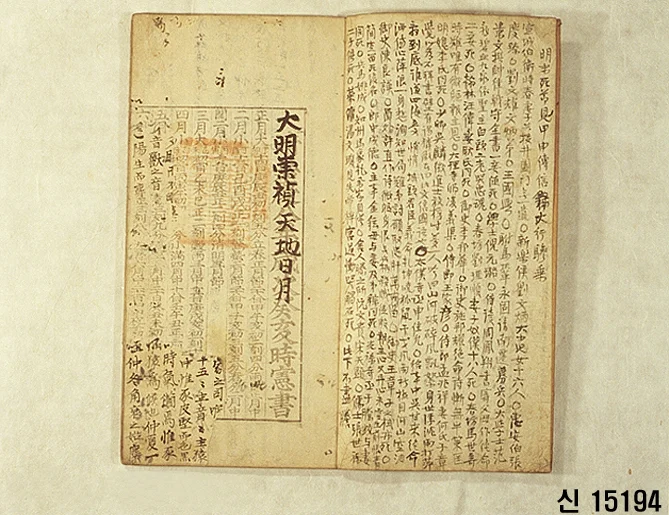
The book in the photograph measures 30.8 cm by 16.8 cm. The museum record dates it only to the Joseon period, so the photograph alone does not tell us which year it covers. To date a copy like this, you would look for the year name on the first leaf and the position of any leap month, just as the specialists did for the 1580 book.
| Mark | Reading | What it tells you |
|---|---|---|
| 大·小 | Long or short month | Whether that lunar month runs to day 30 or day 29. |
| 朔·望 | New or full moon | The conjunction that sets a new lunar month, or the full-moon phase. |
| A pair such as 庚辰 | Stem–branch name | Its turn in a cycle. Look at the heading to tell whether it refers to a year or a day. |
| 宜·不宜 | Suitable or unsuitable | What the almanac’s compilers regarded as appropriate for that date. |
The 宜 and 不宜 columns are conventional labels that the compilers attached to each day. Boreum’s Traditional Almanac panel reproduces labels of this kind with the name of the classical source, but it does not recommend or discourage anything you plan to do. Read them as a record of how earlier readers described a date.
A printed day with a handwritten memory
A book of dates also gave people somewhere to put memories. The Korea Heritage Service catalogue describes how the statesman Ryu Seong-ryong wrote reminders beneath the relevant dates in his printed Daetong almanac. The printed lines tell us how time was organised. His additions show how someone used the book day by day.
When Korea adopted the Gregorian calendar in 1896, almanacs changed too. The court observatory under the Ministry of Education issued a Gregorian-based almanac, and the traditional Siheon almanac began printing Gregorian dates beside the lunar ones. A 2020 paper by researchers at the Korea Astronomy and Space Science Institute summarises the new Gregorian series: it followed 365-day common years and 366-day leap years, arranged the solar and lunar dates differently from the Siheon almanac, and dropped the section listing activities to avoid. From 1898 the Siheon almanac kept its contents but changed its title to Myeongsiryeok, and it continued until 1908.
Boreum’s month grid puts the Gregorian number first and the lunar date below it, so it also carries two systems on one page. In either layout, identify the main date before reading the numbers next to it. For a historic record, keep the original year name, month, day, and any leap-month mark together. The 1580 date above is the result of specialist work on a historic book. The exercise below practises the reading order with a modern calendar.
Try reading a month in Boreum
- Open June 2026 and look at June 15. It is day 1 of lunar month 5.
- Open July 14. It is day 1 of lunar month 6. July 13 is day 29 of lunar month 5, so lunar month 5 was a short month that year.
- Expand Traditional Almanac on a date to find the day’s stem and branch. The lunar date tracks the day within the month. The stem–branch name tracks its place in a sixty-day cycle.
Compare June 15 (Gyeongsin, 庚申) with July 14 (Gichuk, 己丑). Both are the first day of a lunar month, while their stem–branch names differ. The sixty-day cycle continues across the month boundary and never resets when a new lunar month begins. An old almanac that prints both the lunar number and the stem–branch name in each day’s box lets you see that difference at a glance.
Quick check · Why did the leap fourth month help date the book?
References
- Korea Heritage Service · catalogue entry for the Gyeongjin-year Daetong almanac, Treasure (Korean) ↗
- Korea Heritage Service · the Andong Ryu family documents (Korean) ↗
- National Museum of Korea · Almanac (Siheonseo), Sinsu 15194 (Korean) ↗
- Bahk U. M., Mihn B.-H., Lee K.-W., Kim Y. G. (2020), Verification of Dates in the Calendar Sheet for the 31st Year of the Reign of King Gojong (1894), Publications of the Korean Astronomical Society 35(1): 1–16 (Korean) ↗
- National Institute of Korean History · astronomical instruments and calendars (Korean) ↗
- Academy of Korean Studies · Korean almanacs (Korean) ↗
- Korea Astronomy and Space Science Institute · 2026 calendar data (Korean) ↗